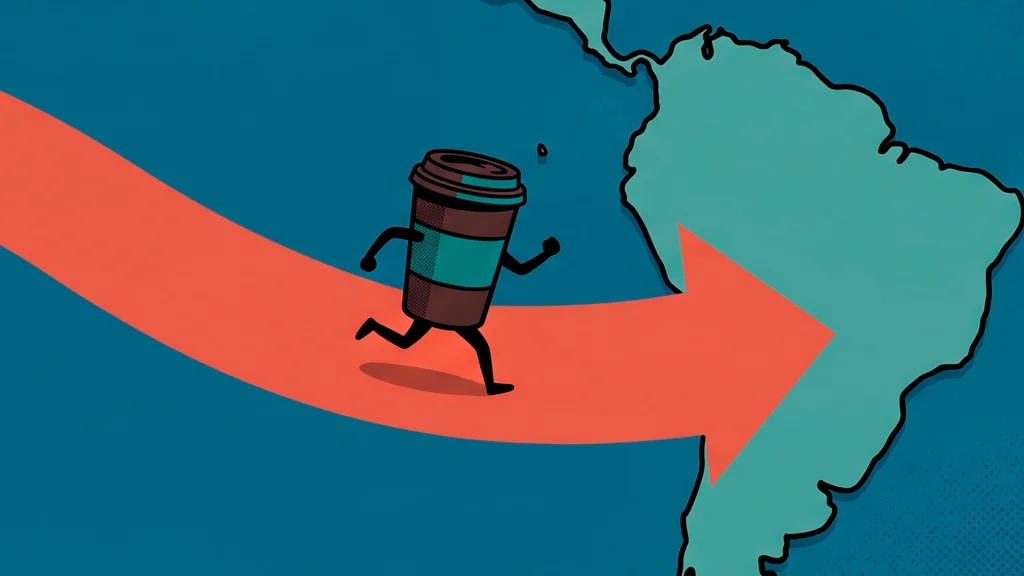
- Chinese coffee chains are expanding into Europe with their low-price, high-efficiency model
- Europe accounts for more than 32% of global coffee consumption – making it an attractive target market
- There may be a limit to how far Chinese brands can reshape consumption – but it will likely cause segmentation
Over recent decades, coffee retail has largely globalised through familiar formats: the coffee shop as a “third place”, balancing convenience with atmosphere. But a new model is now expanding – one built not on experience, but on speed, scale, and price.
Chinese coffee brands are rapidly entering international markets. And they bring with them an operating system centred on app-based ordering, dense store networks, and aggressive pricing. Rather than exporting coffee culture, they are exporting efficiency.
Europe, with its high consumption and rising prices, is an obvious next stop. In this environment, low-cost, high-efficiency operators are well-positioned not just to enter the market, but to capture market share and influence how coffee is sold at scale.
A different kind of competition
The expansion of Chinese coffee chains represents more than just new market entrants. It introduces a fundamentally different approach to coffee retail in Europe.
One of China’s largest coffee brands, Cotti Coffee, operates more than 10,000 outlets across 28 countries. In early 2026, it opened locations in the UK, France, Germany and Spain, with reports that it plans to expand to Italy, Belgium, Portugal and the Netherlands in the near future.
Although not yet physically present in Europe, Luckin Coffee also recently surpassed 30,000 stores and 450 million customers, with expansion across Asia and into the United States. As they set their sights on the European market, it has been reported that they plan to acquire Costa Coffee, Europe’s largest coffee chain.
Dr. Steffen Schwarz is the Founder and Managing Director of Coffee Consulate, and the publisher of ‘The Coffeologist’ newsletter.
“It is highly significant, because it marks the export not merely of a brand, but of an entire operating logic,” he says. “This is no longer a domestic Chinese success story; it is the emergence of a new competitive template in global coffee retail.”
This “operating model” focuses on output over experience. Small format stores, app-led ordering, and rapid pickup replace the traditional coffee shop environment. Pricing is equally disruptive – in Germany, early reports of Cotti Coffee’s arrival have highlighted espresso priced at €0.99 and cappuccinos below €3 – cheaper than local offerings.
“These brands are internationalising speed, algorithmic retail, app-native loyalty, dense store networks and radical price efficiency,” Steffen says. “In other words, they are testing whether coffee can be scaled globally more like food delivery, convenience retail or fast fashion than like the classic European coffeehouse.
Why Europe, and where the opportunity lies
This model is a sharp contrast for European coffee markets – where coffee shops have historically balanced beverage quality with a sense of place which encourages more time spent in a location.
The result is not a direct replacement of the model, but a parallel to it. Chinese chains are not attempting to replicate European coffee culture – they are competing on entirely different terms.
The timing is also critical. European coffee markets are under ever-growing cost pressures, driven by rising green coffee prices, labour, rent, and energy. Coffee prices are still high compared to the last few years, and further consumer price increases are expected.
Europe remains the largest coffee-consuming region in the world, accounting for more than 32% of global consumption in 2025 and the top 10 coffee-consuming countries per capita.
A combination of high consumption and rising prices creates a clear entry point for lower-cost operators. However, Steffen believes that consumers won’t abandon specialty coffee, even with cheaper options available.
“Rising prices do not automatically mean consumers abandon specialty [coffee]. In many European cities, specialty coffee has become a cultural marker of taste, ethics and neighbourhood identity,” he explains.
Instead, price pressure is widening the gap between different types of consumption. Rather than displacing specialty or traditional coffee shops entirely, lower-priced, Chinese coffee chains are more likely to capture specific “moments” – for instance, takeaway purchases, commuting, or other convenience-driven occasions.
“What higher [coffee] prices do is widen the gap between coffee-as-experience and coffee-as-functional daily habit,” Steffen explains. “That gap is where ultra-efficient competitors can thrive.”
Is tradition a structural limit?
Despite the attractiveness of the European market, cultural factors remain a significant constraint for the expansion of Chinese coffee brands abroad. European coffee consumption is widely embedded in routine, identity, and social behaviour.
“Traditions defend meaning more than they defend market share,” Steffen says. “Such traditions make it harder for a newcomer to define the category on its own terms. They resist any model that appears to misunderstand what coffee is ‘for’.”
As a result, ultra-efficient chains are more likely to reshape the middle of the market than displace its foundations. A fast, app-based coffee purchase serves a different purpose to a sit-down coffee experience – and increasingly, the two will coexist.
“Ultra-efficient chains have typically excelled by compressing friction, compressing wait times and compressing price. These are different value systems [to what we have in Europe].”
The expansion of Chinese coffee chains is unlikely to redefine European coffee culture outright. But it may still influence expectations around price, speed, and convenience.
“This can reset consumer expectations around price, speed, app integration, promotional intensity and store economics,” Steffen explains. “It may also force incumbents to sharpen their proposition: either become more clearly premium, more clearly local, or more clearly efficient.”
At the same time, success in Europe will depend on more than price alone. European consumers and regulators place increasing importance on sourcing transparency and sustainability – meaning that cheaper, faster coffee may not be enough to entirely win the market over.
“Any incoming chain that can combine price discipline with credible transparency will be far better placed than one that competes on price alone,” says Steffen. “In Europe, a cheap coffee may win attention; a trustworthy system is what wins permanence.”
The result is not a takeover, but a recalibration. Europe’s coffee landscape is unlikely to be replaced – but its direction will no doubt be affected by a new model that prioritises efficiency over tradition – and scale over ceremony.
Coffee Intelligence
Want to read more articles like this? Sign up for our newsletter