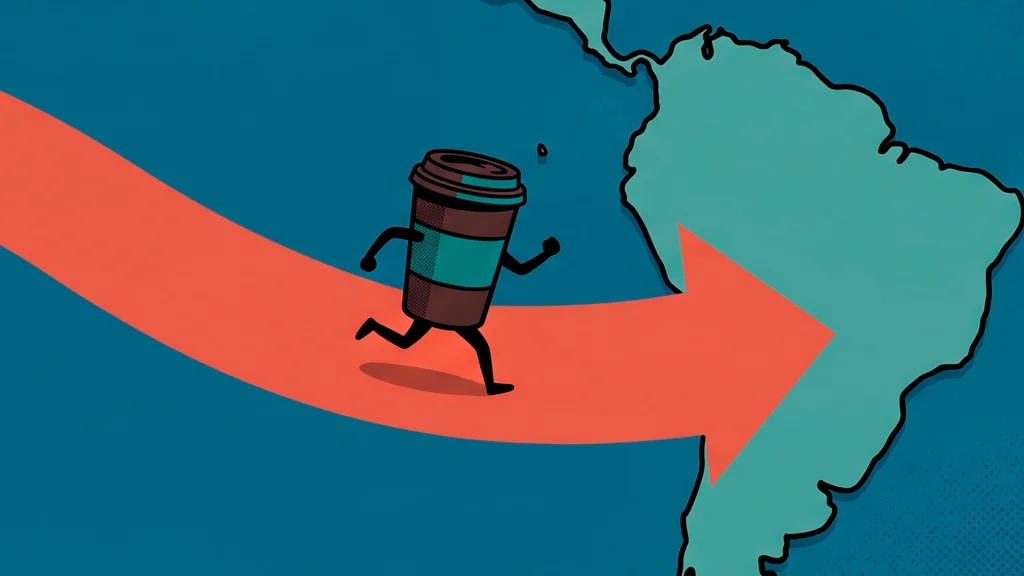
- Coffee contracts are breaking under pressure – with prices swinging nearly 40% in a year
- Rigid “no-default” rules are exposing who truly carries the risk
- Sustainability needs shared risk – up to 90% of value still bypasses coffee producers, undermining the supply chain they rely on
CONTRACTS are meant to provide enforceable certainty in an uncertain business. In coffee – a product whose price can swing up to or more than 40% in a year on the whim of weather, currency moves or speculative funds – certainty is a luxury buyers and sellers crave.
So for the coffee industry, contracts have long been the anchor that helps them manage risk in a sea of insecurity and volatility. Roasters want guaranteed quality and delivery; traders want predictable margins; producers want the purchase commitments that justify planting the next crop.
Yet as coffee prices spike and crash, contracts and commitments set in stone are proving to make less business sense for all parties involved. A growing debate questions whether an uncompromising “no defaults” regime truly makes markets more secure – or simply shifts risk toward the most vulnerable.
“Strategic” defaulting is when a change in market conditions – such as the price of coffee – makes it more advantageous to abandon one contract in favour of another sale.
“Periods of high prices should be a windfall for producers – a chance to recover after years of selling below cost,” says Ashlee Tuttleman, Global Coffee Lead at VOCAL Network. “But the fact that only a few can benefit shows how uneven the system is.”
“Procurement practices often shift risk away from buyers and onto farmers, who already face the greatest exposure. When buyers cancel contracts or delay payments, it undermines stability not just for producers, but for the entire chain. Everything is connected – a system that protects one end by weakening the other is ultimately self-defeating.”
Coffee Barometer’s 2020 edition finds that the average green coffee export value accounts for less than 10% of the US$200 to US$250 billion of revenues generated in the coffee retail market – that’s 90% of value that still bypasses coffee producing countries, which makes the case for shared risk in supply chains.
Beneath the legal structures and exchange rules lies a messy truth: agribusiness doesn’t always follow the spreadsheet. When contracts fail, livelihoods and supply chains can unravel. When they are enforced rigidly, sometimes the outcome is just as damaging.
“The economic risk sits squarely with producers – which feels deeply unfair when we already carry the full production risk from climate and weather,” says Irene Villavicencio, 5th generation coffee producer and marketing manager & brand strategist for MAV Coffee in El Salvador. “I only get one harvest a year in El Salvador, one chance to make a profit, and even then it’s often just enough to keep the farm running.”
“Most farms barely break even. At MAV Coffee, any small profit goes straight back into salaries, communities, and better varieties – we even sell pruning wood as firewood to make ends meet. Meanwhile, buyers in consumer countries hold the negotiating power, so the financial and compliance burden falls on us. The result is less predictable income, less investment, and more vulnerability when prices drop again.”
Three tensions define today’s question of contracts and defaults: where responsibility lies, whose risk is being managed, and whether sustainability – of farmers, firms or ecosystems – can be built on fear of financial ruin.
Responsibility without resilience
At the Swiss Coffee Trade Association’s recent forum in Basel, traders, roasters and financiers spoke about partnership, empathy and trust. At the same time, conversations often returned to a harder line: blacklisting producers who default and refusing to work again with those who can’t deliver.
The logic is contractual clarity. When producers, exporters, importers and roasters sign at a given price, they are obliged to deliver on their commitment even if the market moves against them. Many in the industry argue this is fair: when producers buy inputs cheaply and sell high, they pocket windfalls. However, over the last 30 years, this has happened less than 10% of the time. And when the cycle reverses – as it periodically does – they must honour commitments even at a painful cost.
For the importer, the risk to be managed when faced with a contract default from an exporter or producer is delivering coffee to the roaster that meets their quality and origin requirements, price, and timeframe – not always an easy feat. Defaults can also happen from the roaster, in which case the importer then manages the risk of assuming the loss and the unlikely scenario of finding a new buyer for the coffee.
“Liquidity is a missing link,” says Ashlee. “Even when prices rise, most producers can’t access cash fast enough to benefit. Payment often arrives months after the coffee leaves origin, forcing farmers to borrow at punishing local rates just to cover costs.”
“Buyers could easily change this – through faster payments, pre-finance, or credit extensions. These are not radical ideas; they’re fair ways to share financial responsibility in a value chain that depends on producers’ resilience.”
Liquidity at origin is neither steady nor assured. In Latin America, financing a harvest can require informal loans at annual interest rates of up to 30%. A sudden rally in the C-market can double local cherry prices overnight. When a better-paying middleman arrives, the choice becomes: fulfil a contract and lose money, or breach it to survive another season or to make up for years of loss.
In November 2021, an article from Reuters stated that Brazil, Colombia, and Ethiopia – the three largest producers of arabica coffee in the world – were all seeing an increase in contract defaults from farmers. In late 2021, Euronews reported that up to 1 million bags of coffee had failed to be delivered in Colombia alone because of contract defaults. According to Reuters, several high-profile coffee traders, including Louis Dreyfus Company and Volcafé, sued hundreds of Brazilian coffee farmers for failing to supply coffee as contracted.
Today, with prices higher than ever – reaching $4.16 per pound on November 10th – the industry faces the same dynamics, with an additional layer of sustainability compliance and US tariffs looming ahead.
“Sustainability has to move from ‘prove and comply’ to ‘co-invest and evolve,’” says Irene. “Shared risk is what makes farmers resilient and supply chains stable. Without it, everything stays fragile.”
“That means practical things: pre-competitive finance so buyers can offer forward payments safely, shared-risk contracts that preserve predictability, and better farmer organisations that can weather volatility. Even small steps – like buffer funds or real investment in traceability – can make a huge difference. When buyers co-invest, everyone grows.”

Whose risk is being managed?
Risk management in coffee typically refers to hedging and derivatives – tools that insulate traders and big roasters from price swings.
At the SCTA forum, commodity exchanges were repeatedly praised as the “north star of trust.” But, as sustainability specialist Ashlee Tuttleman noted, these mechanisms are “alien to most producers and divorced from the realities of farming.”
Farmers manage different risks: unpredictable rainfall, pest outbreaks, land tenure, the cost of fertiliser and even the social licence to continue farming. Most of those risks never enter the contract. What does enter is the obligation to deliver – backed by penalties.
When markets spike, the value of that contractual obligation skyrockets. And here timing becomes everything. A trader may have hedged months earlier, locking in a robust margin – so a producer default threatens accounting, not survival. Meanwhile, the farmer faces insolvency if forced to deliver into a market that has run away from the agreed price.
Big roasters and importers insist they rarely enforce bankruptcy on smaller partners – not least because killing the cow starves the milk supply. But the threat of blacklisting remains. Reputational penalties can be as lasting as legal ones.
The effect is uneven. When the rally favours exporters, profits accumulate in trading offices in Hamburg or Geneva. When it punishes those at origin, defaults provoke disciplinary measures. The asymmetry is obvious across the value chain.
As Tuttleman argues, “short-term price spikes are not long-term solutions.” Hedging volatility is one thing; shifting it consistently to the farm gate is another.
Sustainability cannot be signed away
Coffee’s sustainability rhetoric has evolved rapidly. Brands now market stories of soil regeneration, farmer empowerment and climate resilience.
Yet the flow of value remains concentrated away from those featured in the marketing. The premium on “producer stories” tends not to return to the storytellers.
A rigid no-defaults culture can undermine the very partnerships sustainability depends on. If a co-operative collapses under contract losses, years of investment in agronomy, traceability or quality vanish. Hard-won trust evaporates, lenders grow cautious, and next season’s crop can shrink.
“The fact that only some producers are able to reap the benefits of these high prices exposes structural issues with the sector and especially the role of a range of procurement or buying practices of downstream actors that offset risk for buyers in the short term – or so they think – to the detriment of farmers immediately, and ultimately to their own detriment through defaults,” says Ashlee.
“Everything is connected, and the chain is only as strong as its weakest link. The inaction to help offset risks for others, especially when buyers have the power to do so for producers, is ultimately self-defeating.”
The stakes are higher than revenue. If default penalties push farmers out of coffee, roasters may find that upholding contract “integrity” has cost them the future supply itself.
Some roasters and traders are experimenting with more flexible clauses: renegotiation triggers when the fixed or differential contracts shift beyond agreed bands, capital-access support tied to delivery, or shared hedging costs. These are nascent steps, but they recognise a truth markets often ignore: contracts signed under duress are not reliable instruments of long-term security.
“We need to move away from patronising enforcement models toward contracts that build flexibility and share the upside – things like indexed agreements with a floor price,” says Irene.
“Traders and financiers could also step up by helping farmers navigate new regulations and offering real financial backing, through guarantees or warehouse finance. That kind of partnership protects both supply security and farmer resilience.”
Contract enforcement matters. But a world that insists every contract be fulfilled regardless of circumstance risks a brittle supply chain – one that looks robust in spreadsheets yet fractures under real-world stress.
“Contracts need to move beyond transactions and toward partnership,” says Ashlee. “That means building in shared-margin clauses, price adjustment mechanisms, or minimum-price guarantees that protect producers from downside shocks while giving buyers long-term security.”
“Finance institutions also have a role – recognising producers as an investable asset class, offering credit that doesn’t rely on collateral, and extending grace periods. Most smallholders don’t even have contracts at all – just spot deals. So the first step is formalising trade and shortening supply chains to build real accountability.”
Coffee’s future depends not on eliminating default risk, but on understanding it: its causes, its consequences, and who bears the cost. The question is no longer whether a contract is upheld, it’s whether contracts can evolve to reflect that in coffee, as in farming itself, certainty comes in nuanced shades – and sustainability demands that risk be shared, not merely assigned.
Coffee Intelligence
Want to read more articles like this? Sign up for our newsletter here.