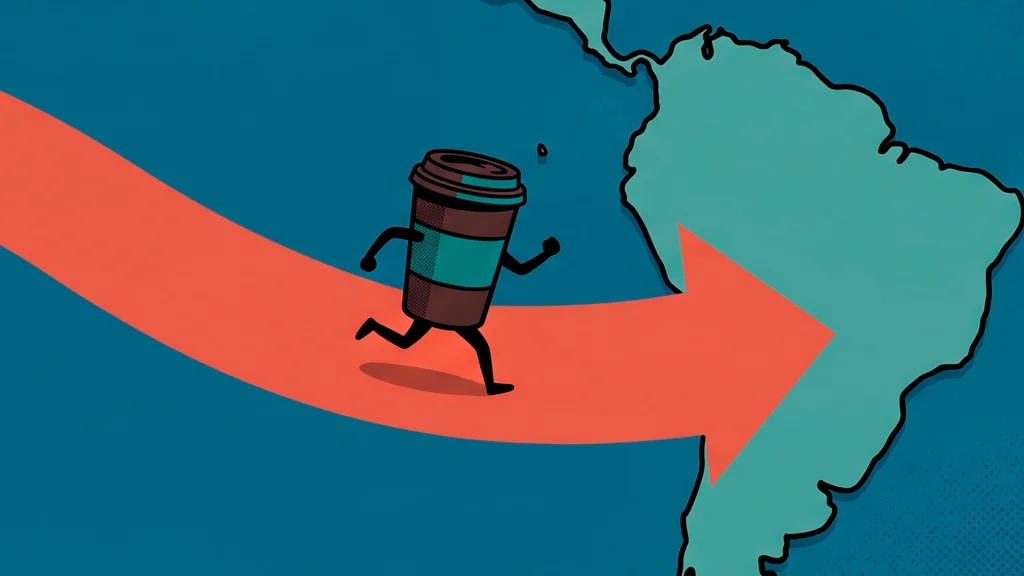
- Many competition coffees now show adjunct-driven aromatics once labelled as “flavoured”
- 75% of young coffee drinkers in the UK opt for flavoured syrups
- Why are some methods of flavour manipulation acceptable, but others considered inferior – and who decides?
FOR decades, specialty coffee drinkers have prided themselves on purity: varietal, altitude and terroir expressed with minimal intervention.
Hazelnut syrup belonged in mass-market jars, not competition cafés. Vanilla aromas were a sign of artificial adulteration designed to make coffee more palatable to the less erudite consumer. Gen Z craves customisation and flavour choice – in fact, 75% of young coffee drinkers in the UK opt for flavoured syrups. For many specialty coffee industry veterans, this is disheartening.
Yet wander into many cutting-edge roasteries today and the menu reads like a confectioner’s: lychee, cherry soda, strawberry compote, watermelon candy. These coffees often smell more like tropical candy than anything emerging from soil. They are marketed not as flavoured but as “infused”, “co-fermented” or “anaerobically processed” – vocabulary that suggests science rather than syrup.
The same drinkers who deride supermarket caramel blends marvel at a microlot that tastes like Skittles.
A shift is under way, blurring a once-sacred line between “specialty” and the flavoured products long dismissed as vulgar. Behind it lies a debate about who gets to decide what counts as quality in a rapidly evolving industry.
“I don’t really see it as a double standard – there’s just a clear quality gap between the two,” says Vic Scutari, green buyer for Brandywine Coffee Roasters. “Traditional flavoured coffee uses pretty rough ingredients, including propylene glycol to get the flavouring to stick, and it wrecks grinders. It’s just a low-quality way of adding flavour, which is why people are fine with syrup in a latte but not with flavoured beans.”
“Co-ferments are totally different. There’s intention, skill, a story behind it, and a lot of transparency. And honestly, fun matters. You can enjoy a super-clean washed coffee and get excited about a wild fruit-forward co-ferment. Having a preference doesn’t make your preference the ‘correct’ one.”
Reddit threads, coffee competitions, and auctions have treated both artificial flavouring and infused and co-fermented coffees as a betrayal of authenticity. The Specialty Coffee Association (SCA) disallowed artificially flavoured beans in competitions – a rule they changed in 2023, allowing infused or co-fermented coffees.
But the gatekeepers’ rules are proving flexible when the “right” producers and roasters push boundaries. Co-fermentation – adding fruits or other adjuncts during fermentation — has exploded in competitions and high-end cafés. It is touted as a way to “unlock” new flavours and enhance terroir. In practice, many lots are simply infused with fruit pulp or botanicals after processing, a method arguably as artificial as traditional flavouring, however natural or scientific.
Yet these coffees are celebrated as innovation, not contamination.
“The divide, as I see it, emerges from the rise of neo-craft,” says Dr. Belinda Zakrzewska, Assistant Professor at Birmingham Business School, University of Birmingham. “This movement, like earlier craft ideals, positions itself against mass production, industrialisation, and standardisation, such as the model associated with Starbucks.”
“What sets neo-craft apart is that it distances itself not only from mass producers but also from traditional craft. According to research by Alessandro Gandini and Alessandro Gerosa, it does this by seeking creative ways to signal marginal distinctions through experimentation and narratives about authenticity. The movement is also driven by a specific demographic, often middle-class white men who have elevated historically low-wage jobs, which is visible in the craft beer industry. Because neo-craft is an elitist movement, the double standard reflects the influence of those who hold the cultural power to decide what counts as legitimate practice.”
The contradiction is stark. Hazelnut coffee sold at Dunkin’ or Jacobs is treated as a chemical indulgence – unserious, unsophisticated, for people who don’t like coffee for its taste qualities, but rather its effects. Meanwhile, a co-fermented Colombian yellow Pacamara from Dak Coffee Roasters can fetch €25 for 250 grams and be a hit amongst specialty coffee aficionados. The difference lies less in flavour chemistry and preferences than in branding and who wields status.
“The producer’s identity often determines whether something is seen as ‘authentic,’” says Belinda. “If a global chain released blueberry-infused beans, for example, purists would likely dismiss it as gimmicky. But if a small Colombian farm, backed by a respected roaster, used the same technique and called it experimental fermentation, it would be celebrated.”
“The difference is organisational identity. Large chains are viewed as profit-driven, so when they adopt craft-like practices, it clashes with what consumers expect – much like craftwashing in beer, where brands hide their corporate owners to protect an aura of authenticity. Small farms, by contrast, fit cultural ideas of craft: small-batch, creative, hands-on. And when a well-known roaster lends credibility and visibility, it reframes the same intervention as innovation rather than strategy. I’ve seen similar dynamics in my research with Michael Beverland and Stephan Manning, for example when indigenous potato producers in Peru entered fine dining only after elite chefs endorsed them.”
Economics, innovation, or both?
Innovation is not the only force at work. Infused coffees offer a compelling financial proposition for producers.
The 2004 SCA cupping form, a grading system that underpins high pricing, scores flavour by rewards intensity, quality, and complexity. Anaerobic and adjunct-heavy methods push flavours into overdrive, sometimes helping a mid-grade 82–84-point coffee jump into the 87–90 bracket – enough to double or triple the price.
This allows farmers with limited access to elite varieties or perfect climate to compete in premium markets. In regions facing rising production costs and volatile markets, that is no small incentive. Why struggle to sell traditional washed coffee at $3 per pound when a fruit-infused lot can fetch $15?
“If it’s perfectly normal for a barista to pump vanilla syrup into a latte, why can’t a producer do something in that same spirit during fermentation?” says Vic. “Why should that be off-limits to them? That feels like the real double standard to me.”
“These processes can genuinely help farmers earn more – and they deserve that. If it throws off some people’s idea of what coffee ‘should’ be, that’s really their issue. Coffee doesn’t have to fit into one box. People enjoy it in all kinds of ways. And honestly, fun and value matter just as much as tradition. Different coffees shine in different moments, and that’s part of what makes coffee exciting.”
In that context, it is unsurprising that roasters who once insisted on transparency and terroir now treat sensory manipulation as progress. The line between “taking liberties” and “adding value” is increasingly subjective – and market-driven.
“For many farmers, especially those under financial strain, these processing methods can be a crucial economic tool,” says Belinda. “The concern that they might be treated as a shortcut is also valid, and I think they should be evaluated within their specific socio-cultural context, on a case-by-case basis. It is difficult to offer a single clear answer.’
“There is a real risk of distorting ideas of quality and value. Infused coffees can complicate notions of authenticity when they overshadow the inherent qualities tied to varietal and terroir. This is why transparency becomes so important and why establishing clear categories, such as co-fermented and infused coffees in contrast to terroir-based coffees, is useful. Clear categories help prevent all coffees from being treated equally and, in turn, allow consumers and judges to use criteria that fit each type of coffee to authenticate them.”

A muddled future for meaning & standards
Purists warn of a slippery slope. If a coffee tastes like strawberries because strawberries were added, is it still coffee? Should consumers know what went into the tank? Could the pursuit of novelty erode trust in scoring systems and origin identity?
Some competition judges already grumble about “processed flavour bombs” crowding out subtle expressions of terroir. Regulators have not kept pace with fermentation trends.
“I don’t think we need strict rules – just honesty,” says Vic. “If something went into the tank, say it. Fruit, yeast strains, botanicals, extracts, whatever. Transparency helps people choose the kind of experience they want, whether that’s a classic washed profile or a big, loud fruit-bomb.”
“As for competitions, they can make whatever rules they want. My focus is on giving consumers great, memorable experiences in the cup. There’s plenty of space for both tradition and experimentation. Coffee should be fun – and different moments call for different cups.”
But there are upsides, too. If infusion and co-fermentation help struggling farmers earn more from less, a purist backlash could do real harm. And if these coffees bring new drinkers into the fold – younger consumers who see coffee as fun rather than fussy – the industry could gain resilience.
Specialty coffee has long sold a story of provenance and craft. Now new generations of consumers are wondering whether that story is about where coffee comes from and how it’s made – or how it looks and tastes in its final form, regardless.
Research by Michael Beverland, Pınar Cankurtaran, Pietro Micheli, and Sarah Wilner – based on the case of a specialty coffee producer who was innovating at a time when the market was dominated by large second wave chains – shows that educating consumers involves a give-and-take between what producers want to communicate and what consumers already expect from a product category.
The irony is difficult to ignore: what is shunned when mass-market brands do it is applauded as pioneering when boutique players do the same. The distinction between “infused” and “flavoured” is as much about class and culture as chemistry.
Perhaps the real question is not whether co-fermented coffees are authentic, but who has the authority to define authenticity. The future of specialty coffee may depend on admitting that taste evolves – and that gatekeeping often has more to do with social signalling than quality.
Coffee Intelligence
Want to read more articles like this? Sign up for our newsletter here.