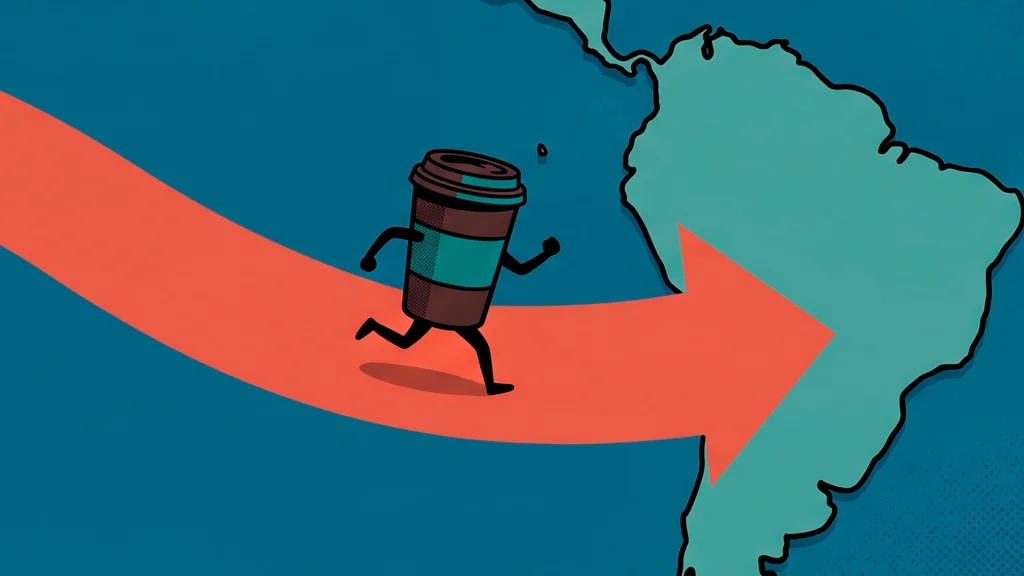
- Big roasters are launching their own “indie” specialty brands instead of buying them, a shift led by giants like UCC, Lavazza, and Farmer Brothers
- Nestlé acquired Blue Bottle in 2017 at a $700m valuation
- Building micro-brands in-house avoids messy acquisitions, giving corporations mimicked authenticity at a fraction of the cost
FOR years, large coffee conglomerates courted credibility by acquiring smaller specialty roasters.
Nestlé bought Blue Bottle, JAB Holdings scooped up Stumptown and Intelligentsia, and Lavazza snapped up Kicking Horse. But a decade on, those bets are losing their shine. The new strategy, quietly taking shape across the industry, is not to buy the next Blue Bottle – but to build one.
From Japan’s UCC Coffee to Italy’s Lavazza and US-based groups like Farmer Brothers and Westrock Coffee Company, a wave of global roasters is creating small, standalone specialty brands under their corporate umbrellas.
These “micro-divisions” often look and sound like independent roasters – complete with minimalist packaging, sustainability language, and direct-trade sourcing stories – yet are wholly owned by large coffee operations.
“I think what’s happening is that big roasters have scaled up so much they’ve entered a very different kind of market – highly competitive, less community-driven, and frankly less fun than before,” says an anonymous coffee industry consultant.
“In some ways, they miss what they used to be part of. Launching smaller specialty brands lets them reconnect with that culture and those higher-margin segments they once came from.”
UCC Holdings, one of the world’s top five largest independent coffee companies that offers private-label coffee, has launched several such projects in Europe and Asia, crafting sub-brands aimed squarely at younger, ethically minded consumers. Lavazza, too, has experimented with boutique offshoots, launching limited-edition single-origin lines under its brand 1895 that borrow heavily from specialty coffee aesthetics.
In the United States, SumOne Coffee, led by the established brand Farmer Brothers, is an example of this new model: a specialty brand conceived within an established roaster’s ecosystem, not outside it.
The logic is simple. Why buy an expensive, messy small business when you can engineer its appeal in-house? Acquisitions mean inheriting founders, debt, culture clashes, and legacy systems – all difficult to integrate. A clean-slate division offers creative control without the complications.
“I think it comes down to authenticity and having a good pulse on the consumer and trends,” says Dan Pabst, Manager of innovation and new product development at Melitta North America.
“It’s a crowded category – and developing an authentic brand with character and purpose is important. It can also be difficult to translate brand identity in a lasting way from one owner to the next. Developing a brand from the ground up ensures that the brand identity and values are aligned with all the stakeholders within a company.”
From authenticity to architecture
The move from acquisition to incubation marks a broader shift: the commercialisation of specialty coffee. What was once an artisanal counterculture built on transparency, traceability, and human connection has grown into something much bigger.
When Nestlé bought Blue Bottle in 2017 at a $700 million valuation, the deal was hailed as the future – a marriage of craft and scale. But it also offered some lessons learned. Integrating a brand built on anti-corporate ethos into one of the world’s largest conglomerates inevitably left some early fans behind.
One article by Notch Strategy sums up customers’ mixed reactions well: “Some chided Blue Bottle founder James Freeman for selling out. Others tweeted that this is the end for Blue Bottle. Some even stated flat out that they would never again drink a Blue Bottle Latte. Me? I just chalked it up to a successful brand.”
Many early acquisitions have struggled to maintain their edge, despite achieving mainstream success. Operations standardise, and equipment, sourcing strategies, and pricing structures that made sense for a small-scale roaster often prove inefficient at corporate scale. While these factors are indications of neither success nor failure, change is inevitable, and original authenticity can get lost along the way.
“We’re in a new age of consumer driven information and research,” says Dan. “Today’s consumers are extremely savvy in their ability to research a brand and communicate with a broad audience. Consumers are constantly looking for brands that resonate with them and align with their values. I have no doubt that today’s consumer will call out unauthentic brand messaging and the success of the brand will be short-lived.”
Big roasters appear to have learned the lesson. Instead of buying authenticity, they are now architecting it. A new specialty brand can be built from scratch – same farms, same beans, same quality control – but with a narrative that appeals to a different audience. It is marketing innovation rather than operational reinvention.
“These big companies already have everything in-house – green coffee buyers, marketing teams, accounting, logistics – so launching a new brand is basically like releasing a new product line,” says Anonymous.
“It’s far cheaper and easier for them than acquiring an existing roaster. That gives them economies of scale the independents just don’t have, which inevitably makes it harder for smaller players to compete on visibility or price.”
For producers, this trend is double-edged. On one hand, it promises stable contracts and access to global markets; on the other, it narrows the diversity of buyers.
“This can lead to ‘hostile takeovers,’ where green buyers from legacy companies can sometimes squeeze margins on specialty coffee producers,” says Anonymous.
By launching their own “craft” brands, large roasters can tap into specialty pricing while retaining economies of scale. The result is what some call industrial specialty: coffee that talks like a micro-roaster but moves like a multinational.

A narrowing field
For small roasters, the implications are sobering. The acquisition boom that once provided lucrative exits has cooled. Instead of being bought, they are being outflanked.
There was a time when global coffee companies needed indie brands to stay relevant. Now, with consumer tastes and supply chains mapped in detail, they no longer do. Big roasters have the green coffee sourcing, the roasting technology, and the capital to mimic specialty practices – without inheriting the overheads of a small business.
It also makes financial sense. Buying a roaster with $10 million in revenue might cost around five times that in acquisition premiums. Building a new sub-brand in-house costs a fraction, with lower risk and easier integration.
This shift coincides with a cooling specialty market. Volume growth of high-end coffee has plateaued in North America and Europe, while green coffee prices remain volatile. Some consumer segments may be spending more on specialty, or at least remaining committed to it, but overall people are buying less of it. In the third quarter of 2025, the specialty coffee retail price index fell 9.8%, with sales of the highest-priced coffees down almost 16%.
Once-profitable “mid-80s” lots that balanced quality and scale have become unviable in today’s market. With the C price holding above $2/lb, many mid-tier coffees now cost as much as experimental microlots did in the past. This is eroding margins and collapsing demand, leaving specialty importers and roasters squeezed.
“I think there will always be space for the genuinely small, community-focused roasters – the ones tied to a neighbourhood or a local scene,” says Anonymous. “But it’s the middle tier that’s being squeezed. The very small will survive through authenticity, and the very large will dominate through scale. It’s that middle ground that risks disappearing.”
While “big coffee” launching small specialty brands helps high-end coffee remain accessible and the market diverse with qualities and flavours, risks remain. The proliferation of corporate craft brands could risk crowding out the genuine independents whose experimentation shaped the specialty movement. But opportunities for collaboration with craft brands still remain.
“The opportunity for collaboration has never been better!” says Dan. “One of the main reasons Melitta opened up M-Lab is to provide growth support for regional and emerging brands.”
“A manufacturing and commercialisation partnership that allows these brands to approach growth on their terms without the need to take on debt or outside investment, and retain control of their brand identity and values while taking advantage of larger sales opportunities and growth.”
With marketing budgets dwarfing those of small competitors, the new “big coffee”–owned brands can dominate retail shelves and online channels. But existing and emerging craft brands can still be viable – with the right strategy and investment.
In a market squeezed by rising costs, flat consumption, and heightened competition, craft looks different. For big coffee, the future of specialty is not acquisition, but niche brand architecture.
Coffee Intelligence
Want to read more articles like this? Sign up for our newsletter here.