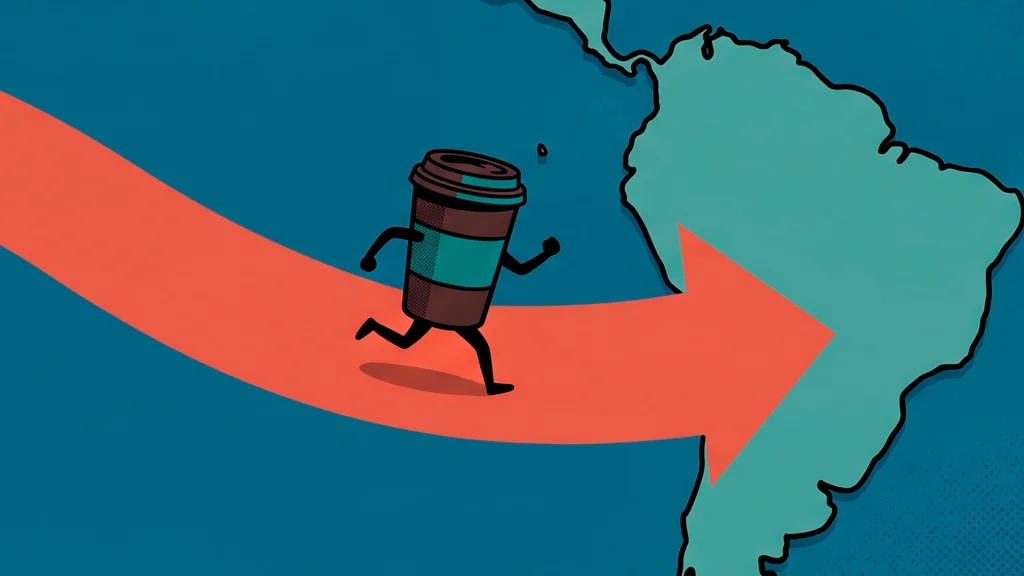
- With coffee futures near record highs, cash-strapped roasters are turning to wealthier farmers for financing – reversing the usual flow of capital
- In Latin America, farm loans can carry annual interest rates of up to 30%
- This raises questions about whether producer credit to roasters is empowerment or hidden subsidy
FOR decades, the global coffee trade has followed a familiar script. Traders in wealthy consumer markets held the purse strings, advancing funds to farmers and exporters to secure supply before harvest.
But as inflation, tariffs, and credit tightening strain coffee companies, a curious reversal is emerging: farmers with access to capital are beginning to finance roasters.
Recently, Philipp Schallberger, Managing Partner of Kaffeemacher in Switzerland, shared a story on LinkedIn that “flipped the traditional script of specialty coffee” with the concept of producers stepping in to offer flexible credit terms or even pre-financing shipments in the context of a high C-price.
“Buying coffee is part relationship, part financial transaction,” says Philipp. “When an exporter, who also happens to be a producer, pre-finances us as a roastery, that too is both: relationship and transaction.”
“It’s a relationship because I’m being given the benefit of the doubt. It’s a transaction because, at that moment, the exporter had sold a lot of coffee on the local market and had high liquidity. When I first brought up the idea, the reaction was immediate and positive. It made sense to him. Because business is always about liquidity, especially these days. And having an open, trust-based conversation about money is relationship-building too.”
The macroeconomic backdrop helps explain how this makes sense. Coffee futures in New York have surged to all-time highs, driven by tariffs on Brazilian and Vietnamese beans, erratic harvests, and speculative fund activity. For roasters in Europe and North America, the cost of green coffee has risen sharply just as retail sales volumes slip. Banks, already wary of volatile commodity markets, are tightening lending.
The result is a cash crunch for mid-sized roasters, some of whom are starting to turn to the very farmers they once financed.
But not everyone sees opportunity for producers. To expect producers to now extend credit – often at zero interest – may replicate the same inequities under a different guise.
“Farmers have been crushed by low prices, double-digit interest, and virtually no access to capital or markets for hundreds of years,” says Martin Mayorga, Founder and CEO of Mayorga Coffee.
“Most roasters didn’t extend zero-interest credit or meaningful risk-sharing through those times. Now, when roasters face tighter cash cycles, decreased lines of credit, and lower margins, they’re asking farmers to extend them credit and then they brand it as ‘innovative partnership.’ This flips the burden back onto the least-capitalised members of the supply chain and repackages extraction as progress.”
“Real empowerment should have roasters carrying more working-capital risk as they have a much higher percentage of profit than producers – not putting even more risk on producers who already finance seeds, labour, inputs, logistics – and survival. Lastly, if roasters are turning to producers for financing, you’d have to assume that this is a ‘last ditch’ option, as any sound business should be able to get financing from a bank or the traders that almost all roasters buy from. This fact makes the financing very risky to producers.”
When partnership becomes pressure
The practice is not without precedent. In other commodities, like cacao, traders and suppliers sometimes extend financing to buyers during liquidity squeezes.
Yet in coffee, the ethical implications are sharpened by a history of asymmetry. Roasters have often framed themselves as patrons of producers, with marketing built on promises of “direct trade” and “relationship coffee.” For farmers now to underwrite those same roasters raises uncomfortable questions.
Latin America offers a cautionary case. Local bank loans for smallholders often carry high annual interest rates. For producers, cash flow is a perennial challenge: harvests are seasonal, yet costs for fertiliser, labour, and debt repayment are year-round. To be paid late by roasters, or to advance credit without compensation, can represent a real loss.
“In many Latin American contexts, producers borrow at punishing annualised rates in the high-20s – or worse,” says Martin.
“If a farmer extends 0% terms to a roaster while paying around 17–20% locally, the farmer is effectively transferring margin – and risk – upstream. That’s a subsidy in plain language. Ethically, it fails the basic test of who can best absorb risk as well as when do producers actually benefit? Capital should flow downhill to origin at a lower cost, not the other way around. If a roaster wants terms, they should compensate for the farmer’s cost of capital or, better, bring cheaper capital to origin.”
Some farmers may see strategic benefit. Wealthier estates with diversified income may accept slower payments if it secures long-term contracts or brand partnerships. In such cases, financing becomes a bargaining chip: leverage to extract better prices or more stable demand. This can rebalance the relationship – at least between capitalised producers and cash-strapped roasters.
“We need to look closely at who we’re working with,” says Philipp. “The case I mentioned in Brazil is very different from other partners, let’s say, in a remote area of Guerrero, Mexico, where producers have multiple income streams with coffee being just one of them, and where coffee is grown on less than half a hectare. Asking these producers for pre-financing would be absurd.”
“Back to Brazil, and taking a punctual view on coffee production, the situation there is very different. And again, buying coffee is partly financial transaction. We don’t have to handle each other with kid gloves. What we do need are upright, honest conversations. With the shared intention of supporting each other. And if someone is comfortable with an idea, why not?”
Yet for the majority, the risk of normalising producer credit is high. Unless structured transparently – with agreed interest, repayment schedules, and clear reciprocity – such arrangements may entrench rather than erode inequality. Instead of roasters investing in farmers’ resilience, the flow of capital reverses, but not the underlying dependency.

Empowerment or just business?
The debate reflects a broader tension in specialty coffee: between rhetoric and reality. For years, the industry has marketed itself as a community built on shared value.
But when economic pressures rise, relationships often revert to pure commerce. If roasters extend support during surplus years but expect lifelines during scarcity, is that partnership – or opportunism?
“I’m not proposing this as a model,” says Philipp. “What works for some does not work for everyone. But still – how could producers benefit from it?”
“We often talk about trust-building when roasters visit farms, bring roasted coffee, spend time, and engage in real conversations. And yes, that matters. But trust-building can also happen the other way around, when exporters pre-finance roasters. Of course we’ll go back to the same producers because they helped us when it counted. That’s how long-term relationships work. And as a matter of fact, the next contracts are already signed. This time, without pre-financing from the exporter, simply because there was no need.”
But without structural change, unless farmers are compensated for the cost of capital, the benefit risks flowing only one way.
“This is priced risk, not free risk,” says Martin. “If producers extend terms, roasters need to pay an explicit finance charge indexed to local borrowing costs so farmers aren’t back-door lenders at 0%. The financing needs to be in addition to a fair price for their coffee.”
“Roasters can help secure lower-cost facilities for co-ops and smallholders – guarantees, pre-harvest lines, inventory finance – so the cheapest capital sits where the need is highest. That’s what ‘direct’ should mean – understanding and improving producers’ financing realities, not ignoring them.”
“We should also avoid vertical integration that strips autonomy. That means keeping producer ownership intact and structure contracts with transparent pricing, shared quality incentives, and floor prices – mechanisms that stabilise farm cash flow instead of extracting float.”
“Roasters can truly commit through advance payments tied to harvest milestones, commitments through cycles – not just when differentials are attractive – and signing cooperative agreements with banks that finance producers. I’ve argued for this model for years because ‘direct trade’ done right is not charity – it’s disciplined, relationship-driven business that allows partners to adjust to the shifting of opportunities, margins, and costs so that our supply chain grows stronger together.”
The truth may lie between. In principle, capital can move in both directions depending on who has the advantage. But empowerment is not just about who writes the cheque; it depends on fairness in the terms.
With high borrowing costs in producing countries, a farmer advancing funds at zero interest is not empowering but subsidising the roaster. Conversely, agreements that mirror local credit rates, or offer flexibility in return for better prices, could create genuine balance.
Ultimately, the shift highlights how fragile specialty coffee’s economics remain. As inflation, tariffs, and climate shocks squeeze margins, even once-secure roasters are vulnerable. Farmers with capital may find opportunities to leverage their position, but whether this represents empowerment or hypocrisy will depend on what comes next: reciprocity, or repetition of old inequities under a new banner.
Coffee Intelligence
Want to read more articles like this? Sign up for our newsletter here.