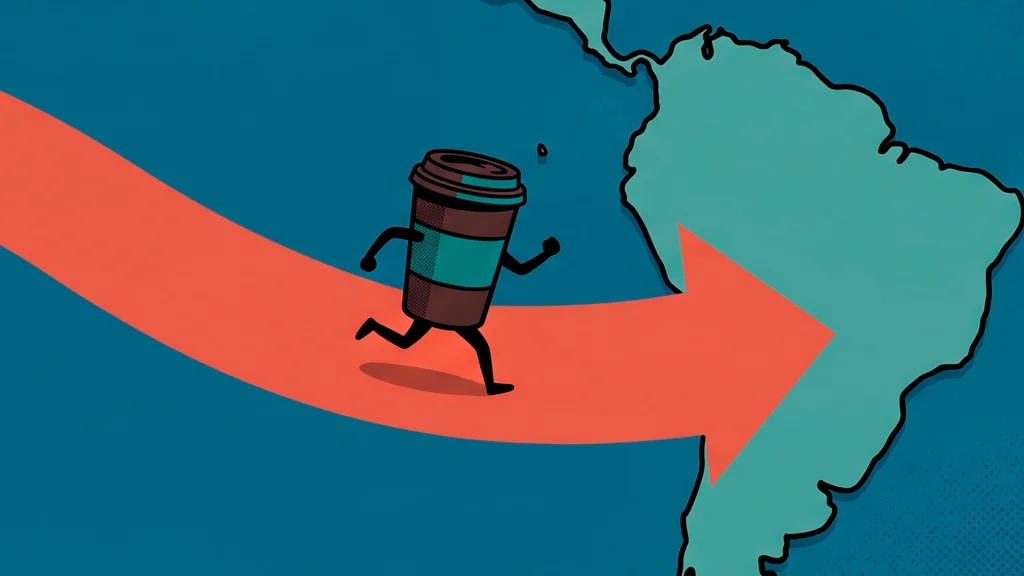
- The global coffee trade is burning out as contracts drag, margins shrink and tariffs loom
- Arabica futures swung by more than 30% in 2023 alone, while shipping delays and rising labour costs compound a wider squeeze
- Smaller exporters and cooperatives face the sharpest strain, raising the question of who survives and how
MANY of the world’s coffee traders are now running on fumes. After a decade of relatively benign markets, the past five years have been a blur of price shocks, shipping snarls, rising labour costs, and now the extra burden of US tariffs.
Contracts once signed in a week now drag on for months, as exporters and buyers repeatedly re-negotiate terms in response to every market swing or policy shift. New US tariffs have added to the chaos, with disbelief over the steep rates imposed on Brazil, the world’s largest coffee producer and price-setter. In Europe, the constantly shifting rules around the EUDR have created what many call “EUDR exhaustion.”
Across the trade, the burnout is unmistakable.
Despite appearing lucrative, today’s high prices are prompting exporters and producers to tread carefully. In such a volatile market, locking in long-term fixed-price contracts exposes them to future financial and sourcing risks. They juggle hedges that swing violently with exchange rates, and swallow delays in ports and paperwork.
The result is anxiety, burnout and what could be called a sector-wide emotional hangover.
“It’s not just the contracts or the shipping delays, those pressures have always been there; it’s realising that the sentiment we sold to the world has very little room for us in it,” says Anny Ruth of Loma La Gloria. “What’s different now is that the industry has been living inside a contradiction for years – and that tension is finally showing.”
“For a long time, we fantasised about wrapping a transactional industry with sentiment. It was a brilliant marketing campaign: coffee became about people, about ‘the many hands’ along the journey of the bean. That story helped justify higher prices, created emotional connection, and gave consumers the feeling that every bag they bought carried meaning. At first, that felt like progress; but now the illusion has turned on us.”
Anny Ruth feels that exporters and growers are running on fumes to keep up with endless demands: better scores, precise cupping notes, shifting taste trends, and a flood of producers desperate to break into ‘specialty’ for higher prices. The long-term emotional weight of carrying the ‘relationship narrative’ on top of all the financial and logistical risk is a big part of the pressure.
Smaller firms feel it most acutely. While global traders like Neumann Kaffee Gruppe or Olam can handle risk more easily thanks to sheer scale, boutique exporters and regional houses face uncertainty with far less buffers.
Investment in marketing, events, and client outreach has slowed as managers simply try to keep the pipeline intact. In a relationship-driven business, the time lost to putting out fires comes at a heavy opportunity cost.
It’s not just traders – the entire coffee supply chain is working overtime to adapt to this financial squeeze, including roasters, producers and everyone in between.
The new normal?
Whether this fatigue is temporary or structural is the central question. Coffee has always been volatile – weather, pests and politics have long dictated prices – but the last five years have been particularly tough.
The COVID-19 pandemic scrambled shipping, climate shocks slashed harvests, and speculative funds piled into coffee futures. Now geopolitics add a new layer of uncertainty, as tariff threats from Washington raise fears of disrupted flows from Brazil, the world’s biggest supplier. Rising labour costs, in Colombia for example, are also applying pressure to pricing and further squeezing margins. Guesswork and investments around EU mandatory and human rights due diligence supply chain regulation are another ball in the air.
These pressures manifest in slower decision-making and thinner margins. Deals once closed on the strength of trust now stall as both sides second-guess future prices or trade rules. Throw AI and a coffee market flooded with predictions and self-made “experts” into the mix, as well as a saturated market and new consumer trends and behaviours that are hard to keep up with, and industry exhaustion seems like a natural consequence.
For green coffee sellers, this means fewer forward contracts and more spot sales; for roasters, it means rising costs, less predictability in blends, and considering lower qualities that were once shunned to balance the effects of the margin squeeze.
“Everyone talks about the rising costs of labour, tariffs, and logistics. Few talk about the invisible costs – and that’s where the real burnout lives,” says Anny Ruth. “On the farm side, it’s an ageing workforce. Efficiency drops because younger generations aren’t lining up to take these jobs. That means investing more in better food for the trees, in power tools to replace labour you don’t have, and in ways to stretch fewer hands further.”
“On the business side, the hidden costs are emotional and financial. You might have a base of roasters, but each year it’s like starting from scratch: ‘Not this year, I overstocked,’ ‘I haven’t finished last year’s bags,’ ‘Your samples didn’t excite me,’ ‘It only cupped at 86.5, not high enough.’ So exporters are forced to concede on prices, and accept discounts. Then there are the hidden costs of working with importers, although we make the sale and connect the roaster while playing by their rules just to make sure coffee gets shipped.”
Many in the trade admit they are doing okay but not nearly as well as during the boom years of easy credit and steadily rising specialty demand. Today, we are witnessing a rapidly changing consumer landscape, with Gen Z consuming much less specialty coffee in the US than previous generations, according to the National Coffee Data Trends Specialty Coffee Report.
The difficulty is not evenly shared. Larger traders, with diversified supply chains and hedging strategies, can ride the volatility. Smaller players must rely on stamina as much as skill. Some are quietly exiting the market, worn down by the grind.
Yet the sector maintains a veneer of resilience: at conferences and expos, the talk remains upbeat overall, and the booths full of showy gimmicks. It seems to be general knowledge that many firms are struggling, but no one wants to be the first to admit it.

Time to adapt strategies or expectations?
If volatility is indeed here to stay, the industry must adapt. Some are looking to streamline contracts, provide real-time shipping data, or automate hedging to ease the cognitive load.
Others are turning to consolidation, with smaller exporters partnering or merging to share risk. Brazil’s cooperatives have shown that pooled resources can keep marketing, training and event budgets alive even in lean times.
But solutions will only go so far. Coffee’s global structure – millions of smallholders, thousands of exporters, and a handful of giant roasters – means that shocks reverberate unevenly. The result is an industry that requires the capacity to keep renegotiating, re-pricing, and re-calibrating in the face of constant flux.
“There’s a huge contradiction at the heart of this industry, and it’s what pushes everything to extremes, and ultimately to burnout,” says Anny Ruth.
“In coffee, quality is equated with taste. But taste is subjective, shaped by your experiences, mood, biases, even your personal connection (or lack of connection) to origin. How can something so human and nuanced be reduced to a standardised point system? That system decides whether your coffee is ‘good’ or not. That’s not just frustrating, it’s structural.”
For many, that is unsustainable. Yet few can walk away: the sunk costs are high, and coffee remains a global staple. Who survives is the big question. Firms who can ride out uncertainty with more capital and less risk, or those able to build longer-term relationships with roasters who value stability over quick wins may have the most capacity to endure.
The cure for the sector’s fatigue could also simply be a recalibration of expectations: accepting that the boom years are gone, and that the business is back to being hard work.
Coffee Intelligence
Want to read more articles like this? Sign up for our newsletter here.