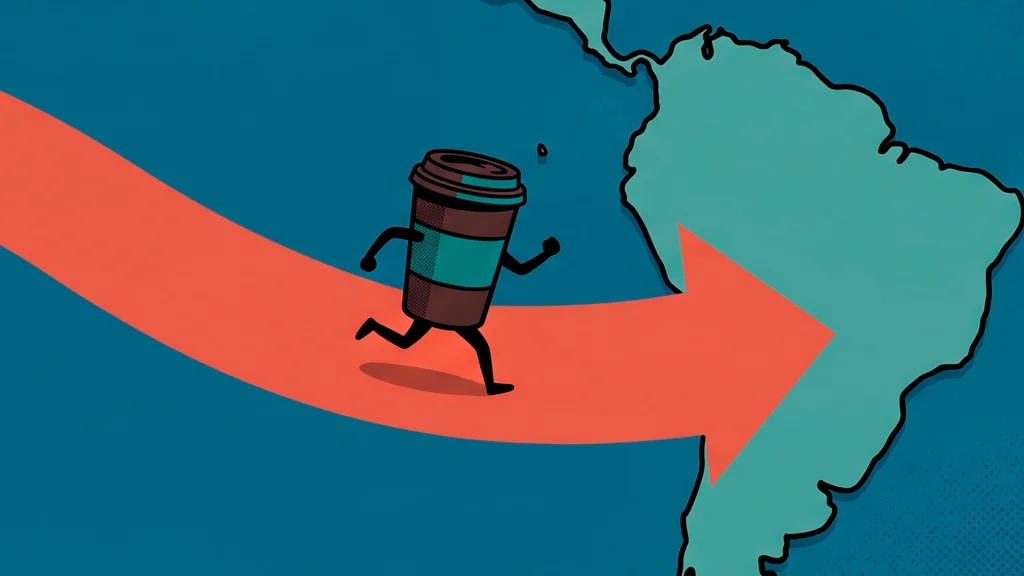
- Coffee prices have surged by over 100% in a year due to strains caused by climate change, political risk, and logistical chaos
- Cacao hit a record $10,000 per tonne in 2024, with potential parallels emerging
- Both global commodities are shaped by smallholders, speculation, and fragile supply chains
OVER the past year, the coffee industry has been turned on its head.
In February 2025, the benchmark price for arabica beans reached over $4.29 per pound, up 109% over the past year and a whopping 145% in the past five years. Robusta, long the lower-priced cousin, peaked in February at around $5,849 per metric tonne on the London Exchange – the equivalent of $2.65 per pound.
Several overlapping crises are triggering this volatility: climate shocks in Brazil and Vietnam, political instability in Ethiopia and Myanmar, and logistical bottlenecks in the Red Sea region and Panama Canal.
Add in rising tariffs, inflation, and currency fluctuations, and the result is a global industry that can no longer take anything for granted – not even our daily cup of coffee.
The turbulence has been particularly painful for smaller roasters and cafés, who now face higher procurement costs, longer delays, and unpredictable inventories.
Meanwhile, multinationals hedge aggressively or vertically integrate, leaving gaps between actors in the supply chain. A once-stable industry is now caught between speculation and scarcity, with producers and buyers struggling to make sense of a market that seems increasingly detached from fundamentals.
In this context, some are turning to another commodity in crisis for clues: cacao.
In December 2024, the price of cacao beans exploded, reaching a record $10,000 per tonne – a near tripling in just 18 months. But neither cacao nor coffee farmers are necessarily reaping the gains.
“Even though prices rise, smallholder coffee farmers do not see an increase of income,” says Pauline Buffle, Director and Co-Founder of FFORA. “On the contrary, with climate change impacts, they are forced to invest more time and labour on their farms.”
Some argue that higher prices could be leveraged to alleviate this pressure. Uncommon cacao warns against the use of the term “price crisis” in a blogpost:
“The reality is that smallholder farmers have been living amidst crisis conditions for years, and the possibility of higher prices to better equip their families and farms for the rollercoaster of climate change and turmoil ahead gives a glimmer of hope for alleviating their lived crises. Let’s be clear – higher prices for cacao farmers are in no way a crisis.”
A similar trend can be observed in the coffee sector, where coffee buyers are having to adapt to a new era of pricing rather than a “crisis” – and where some are increasingly questioning the term “crisis,” asking “crisis for whom?”
Climate resilience and higher prices are linked
Cacao’s sudden price spike was almost a premonition of what would ensue in the coffee sector – and remains interlinked.
The proximate causes were familiar: extreme weather, crop disease, and underinvestment in ageing plantations across Ivory Coast and Ghana, which together produce over 60% of global cacao. A prolonged black pod disease outbreak, erratic rainfall, and an extreme humid heat wave have decimated yields, with West African production falling and prices rising.
In the coffee sector, Brazil and Vietnam are often highlighted as key examples of climate risk – not only because they are major global suppliers, but because their production volumes influence global prices. Yet the threat of climate change extends far beyond these two countries, putting coffee – and coffee farmers – at risk in producing regions around the world.
But the underlying issue is structural. For decades, cacao has operated under a pricing regime that left producers with meagre margins, discouraging farm-level investment. Even as global chocolate demand rose steadily, supply stagnated.
A new report, commissioned by the European Climate Foundation, argued that large chocolate manufacturers should invest in climate adaptation and biodiversity protection in cacao-growing countries.
A recent article in The Guardian – that cites that more than two-thirds of the cacao, coffee, soy, rice, wheat and maize brought into the EU in 2023 came from countries that are not well prepared for climate change – posits that fair prices are directly linked to climate resilience:
“Ensuring farmers are in their supply chains paid a fair price for their produce would allow them to invest in the resilience of their own farms (…) This is not an act of altruism or ESG, but rather a vital derisking exercise for supply chains.”
According to Family Farmers for Climate Action (FFCA) – a growing network of 11 regional farmers organisations representing around 95 million smallholders in the Global South – of the world’s 600 million family farms, 84% are smallholdings under two hectares. Yet in 2021, small-scale farmers received just 0.3% of international climate finance – despite already spending billions from their own limited resources. And only 19% of public climate funding for agriculture that year supported sustainable, resilient practices.
“If we want to build more resilient coffee and cacao sectors, the industry needs to start by listening to smallholder farmers,” says Pauline. “They are the backbone of global supply – and yet are too often excluded from conversations about how to adapt to climate change. Solutions must be co-designed with them, not imposed from the top down.”
“While it may feel less immediate to the coffee sector, we can’t ignore the growing threat to farmers’ rights to save, use, exchange, and sell their own seeds. These customary practices are central to biodiversity, resilience, and food sovereignty – and they’re increasingly under pressure, especially in Africa.”
“One of the most urgent priorities is access to fair, accessible, and effective climate insurance. Smallholder farmers, including those in coffee, are bearing the brunt of extreme weather events with almost no safety net. Governments and the private sector both have a role to play in ensuring farmers don’t shoulder all the risk.”
In West Africa’s cacao sector, governments in the region fixed farmgate prices to shield farmers, but inflation and currency depreciation have eroded real income, with the cost of inputs more than doubling.
When the crunch came, the market panicked. Traders scrambled to cover contracts. Processors raised prices or cut supply. The speculative surge was swift and self-reinforcing. And much like with coffee today, the price signals came too late to rescue short-term supply – and too unpredictably to guide long-term planning.
There are echoes here that coffee stakeholders would do well to study. Both crops are labour-intensive, climate-sensitive, and dominated by smallholder farmers. Both rely on opaque supply chains, where value accrues disproportionately to intermediaries and brands. And both operate in markets where future prices are often decoupled from farm-level realities.

Supply and demand are increasingly disconnected
The idea that commodity prices reflect real supply and demand has long been a comforting myth in coffee. But increasingly, that link looks tenuous.
Coffee’s price, traded on futures markets in New York and London, is often driven less by physical shortages and more by investor sentiment, currency hedges, and speculative flows.
Meanwhile, freight costs exceeded bean prices, pushing roasters to reduce quality or switch origins. What’s clear is that price alone no longer tells the whole story.
That’s not new. Ghana’s cacao sector has long sold most of its crop in advance to secure loans – stabilising prices but limiting gains when markets rise. In 2024, as cacao prices soared, farmers missed out on higher earnings due to pre-locked forward contracts.
Years ago, chocolate-maker Tony’s Chocolonely tried to break with commodity pricing by fixing higher farmgate prices to ensure a living income for producers. In an ironic twist of fate, with the market’s latest surge, is Tony’s now paying less per tonne than competitors forced to chase the market? It seems that even well-meaning pricing models have their limitations when markets dislocate.
Coffee companies, too, have dabbled in direct trade, fixed premiums, and early contracting, sometimes with mixed results. The problem is scale. When prices are low, such models offer stability and fairness. But when they spike, they risk creating perverse incentives – or losing access to supply altogether.
In 2024, Ghana’s cacao regulator, Cocobod, announced it would no longer rely on its long-standing syndicated loan to pre-finance cacao purchases – a model that had constrained the country’s ability to benefit from price spikes. Instead, licensed buying companies (LBCs) must now secure funding independently, mostly from international traders.
The move introduces new risks, especially for local buyers with limited access to credit, but it also offers the possibility of greater flexibility to time sales and improve cash flow.
For coffee, where pre-harvest financing is similarly centralised and often dominated by multinationals, Ghana’s shift offers a valuable lesson: rethinking trade finance could rebalance power and boost resilience across the supply chain.
The broader industry is still coming to grips with this new landscape. For consumers, it may mean higher retail prices and less consistency. For farmers, it could mean windfall earnings one year, and collapse the next. What’s missing is a sustainable pricing framework – one that accounts not just for volatility, but for long-term investment, climate resilience, and equitable value sharing.
The take-away seems to be less about coffee learning from cacao, and more about rethinking agricultural value chains that depend on vulnerable smallholder farmers. Progress will depend not just on pricing mechanisms, but on willingness to confront the deeper issues: who earns what, who bears the risk, and who plans for the future.
Coffee Intelligence
Want to read more articles like this? Sign up for our newsletter here.