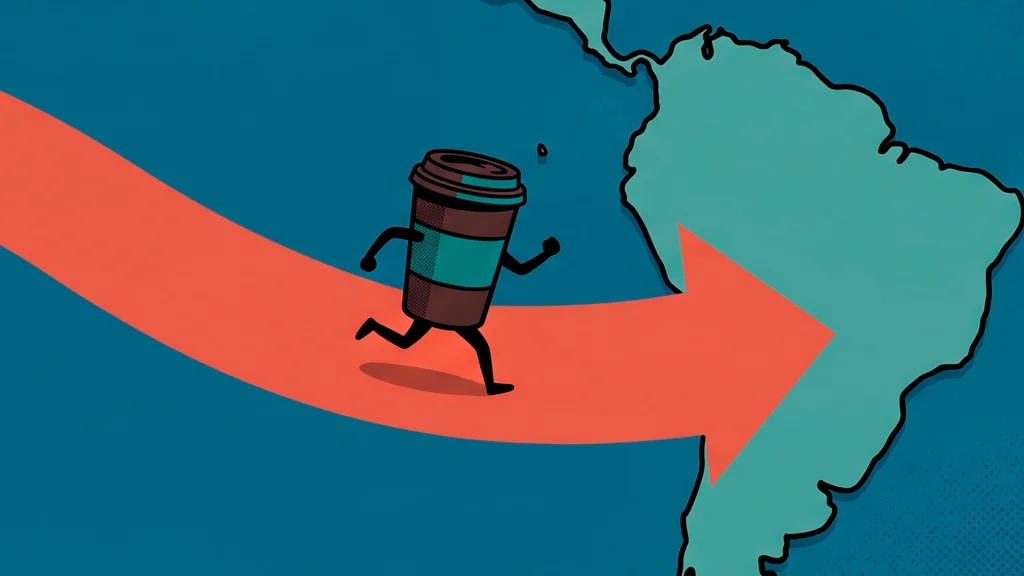
- With arabica futures peaking at $4.41/lb in 2025, premium roasters are turning to robusta
- But is it for sustainability or for survival?
- Once dismissed as bitter filler, robusta is now being rebranded as a specialty contender
ROBUSTA is having a moment in specialty coffee. Once sidelined as the coarse, bitter cousin of arabica, it is now popping up on single-origin menus, featured in café specials, and lauded by roasters as an “exciting” flavour frontier.
But as its stock rises, so too do questions around why – and why now. The short answer is price.
”Personally, I still don’t see Robusta as fully embraced by the specialty world,” says Sami Chbeir, coffee roaster at San Antonio Coffee Roasters. “Flirted with? Maybe. But when buyers start filling their books with Robusta, it’s usually driven by economics, not ideology.”
“That said, if it weren’t for the innovations that have made Robusta an acceptable – sometimes even preferable – option in blends, I doubt we’d be seeing this level of demand.”
With arabica futures hitting unprecedented highs – peaking at US $4.41 per pound in February 2025 – roasters are looking for alternatives. Robusta – formally known as Coffea canephora – long considered the budget bean, has seen its own price climb, but remains comparatively cheaper.
In March 2025, robusta futures on the London exchange hovered around $5,300 per metric ton, equivalent to roughly $2.41 per pound, making it nearly half the price of its more delicate counterpart.
Some say that robusta may be “the future of coffee,” as better qualities become more widely available and the specialty industry and amateur coffee connoisseurs start to consider it more seriously.
It’s no longer just mass-market brands that are capitalising. Specialty and premium roasters – once vocal about “100% Arabica” purity – are embracing blends with up to 30% robusta, citing not just cost savings but flavour innovation.
Brands like Australia’s ONA Coffee have released limited edition fine robusta lines, while specialty coffee focused cafés worldwide now promote “rare robusta” tastings alongside their usual Geishas and Sidamos.
“Some buyers are turning to robusta to hedge against high arabica prices,” says Will Frith, Founder at Building Coffee in Vietnam. “But there’s also this specialty obsession with novelty.”
“We’ve seen it in the rise of extreme processing methods. Robusta offers that same sense of differentiation, of tasting something unfamiliar and surprising. That novelty angle plays a bigger role than most people would like to admit. People talk it up, others get curious, and suddenly everyone wants to try it.”
Robusta is being rebranded and exoticised, now referred to as “unique Amazonian canephoras with wonderful potential” – a far cry from the “rubbery robusta” descriptions uttered by the specialty coffee crowds just a few years ago.
But this is not necessarily a victory for robusta on its own merit – although it has plenty.
In many cases, it is arabica’s scarcity – not robusta’s unique profile – that’s driving the trend. As a result, what began as a climate-resilient alternative is now being marketed more as a high-end novelty or crisis hedge than an environmental or agricultural choice.
From commodity filler to connoisseur’s curiosity
Robusta’s reputation was built on bitterness. Used historically in instant coffee, supermarket blends, and canned brews, its high caffeine content and low cost made it ideal for bulk production – not boutique brewing.
Findings estimate robusta to account for around 30-40% of global coffee production, but for decades, it rarely featured in specialty conversations.
“The fact that so many roasters are just now starting to look at robusta – rather than openly embrace it – says a lot,” says Sami. “It’s still being treated like a second-class bean. Despite all the buzz and genuine innovation around it, I don’t think most specialty cafés are ready to give robusta real shelf or bar space. Even when it’s enjoyable, it’s often seen as too simple to earn a spot.”
For many though, that began to change in the 2010s, as climate models predicted Arabica yields could fall by 50% by 2050. Enter the robusta renaissance – not as a choice, but as a contingency plan. NGOs, research bodies and donors began pouring money into robusta farming, focusing on agronomy, climate tolerance, and post-harvest quality.
The Coffee Quality Institute (CQI) played a pivotal role, launching its Fine Robusta standards in 2010 and training tasters globally to evaluate the variety based on attributes beyond caffeine and crema.
Then came influencers like Sahra Nguyen, a Vietnamese-American coffee educator, who used platforms like YouTube and TikTok to champion Vietnamese robusta and challenge arabica hegemony with facts, flavour notes, and family stories.
More recently, World Coffee Research (WCR) has recognised the need for genetic improvement in robusta on a global scale and is starting to build the foundation for a robusta breeding program, which has launched this year in partnership with key producing countries. The organisation cited both climate resilience and the untapped economic potential for smallholders.
“Back in the ’80s and ’90s, our company wouldn’t have even considered pivoting to robusta because of quality concerns,” says Sami. “That hasn’t changed for us. But I do recognise that with global price pressures, rising consumption, and the impacts of climate change, high-end Robusta may become more of a necessity than a choice.
Still, high-quality coffee doesn’t happen by accident. It’s the result of deliberate innovation. And to answer the real question here: Sourcing any specialty coffee – robusta or arabica – based solely on price is a lose-lose. It’s bad for producers, and ultimately, bad for consumers too.”
As quality improves and consumer curiosity grows, robusta is finally succeeding in shaking off its stigma. But whether deserved or not, its path to redemption has always been reactive: first as filler, then as fallback. Things are changing, but scepticism still remains high as to whether it can legitimately compete with some of the “best” specialty arabicas out there.
“Robusta still gets sidelined,” says Will. “It’s like the rookie in a sports league – good for now, but can it go the distance? There’s scepticism. What used to be outright dismissal has shifted into a more measured doubt.”
“Even those steeped in specialty arabica – where clean, sweet, bright profiles are king – still see robusta as second-class. I don’t see a time soon where both species are viewed as equals. The light and bright crowd might sample it, maybe even say a nice thing or two, but they’re unlikely to embrace it seriously.”
Perhaps the point is that robusta needs to flourish in its own right. As the saying goes, comparison is the thief of joy – and endless comparisons with arabica are doing nothing for robusta’s evolution in specialty circles.
Now, its emerging appeal is more intrinsic. Connoisseurs are finally discussing robusta’s dark chocolate notes, spice tones, and creamy textures – not just its robustness.

From underdog to investment bet
With arabica prices predicted to remain volatile – driven by erratic weather, low yields in Brazil and Colombia, sustained global demand and now tariffs, uncertainty, and speculation – many traders and investors are looking at robusta more seriously.
While robusta prices also reached a 29-year high in Q1 2024, the bean is still seen as more financially and agronomically stable.
“The conditions aren’t improving for arabica. Climate disruption alone is going to blur the line between arabica and robusta in specialty – not as a bold choice, but as a necessity,” says Sami.
“Sure, this current arabica surge may cool off, but like most real shifts, the catalyst has already happened: Roasters have robusta now, and they’re selling it. Whether they’re willing to trade quality down the line – subbing in lower-grade robusta as prices equalise – is going to depend on them and their customers.”
As a result, new origins at scale are emerging. While just six countries – Vietnam, Brazil, Indonesia, Uganda, India, and Côte d’Ivoire – produce 95% of the world’s robusta, we’re now seeing Malaysia, Thailand, Mexico, and Tanzania producing at scale.
Other countries like Ghana and the Democratic Republic of the Congo are investing in Fine Robusta production, with hopes to reach new markets and scale. Vietnam and Brazil still lead production, but investment is beginning to flow into Africa, where infrastructure, R&D, and financing have lagged for decades.
This could be transformational. Africa accounts for only a small fraction of global robusta exports, despite ideal growing conditions in much of the continent, and despite West Africa being the birthplace of Coffea canephora.
As demand for quality robusta rises, countries like Uganda – the largest exporter of coffee by volumes, leading producer of Robusta and second largest producer of arabica coffee, after Ethiopia, in Africa – are well placed to take advantage, especially with investments in drying infrastructure, farmer training, and access to specialty buyers.
On the consumption side, the biggest shift may be in perception. Specialty cafés are reframing robusta not as an arabica substitute, but as a flavour category of its own – like natural vs. washed, or honey vs. anaerobic.
Roasters are learning how to profile and market it, while consumers, especially Gen Z, are less bound by legacy labels and more willing to try “new” experiences – especially if they’re marketed as sustainable, traceable, or simply different.
Still, the risk is that robusta’s rise becomes a speculative trend, driven by commodity market squeezes rather than true appreciation. If prices normalise and arabica rebounds, will roasters drop robusta?
The answer may lie at the origin. If producer countries – particularly in Africa and Asia – can seize this moment to improve processing, build market linkages, and scale fine robusta supply, then the current surge could become a structural shift.
Amid recent geopolitical shifts, Brazil could be readying itself to challenge Vietnam’s dominance as the world’s leading robusta producer and exporter.
That means long-term investment, not just short-term hype.
“I’d love to see robusta unshackled from arabica comparisons entirely,” says Will. “Not judged by arabica’s standards, not talked about only in times of crisis or shortage.”
“Let’s think of it like green tea vs. black tea – same crop, but different products, different consumers, different value systems. Sure, people can appreciate both, but they serve different purposes and palates. Robusta deserves that kind of framing: Not as the fallback, but as something distinct and valuable in its own right.”
As coffee enters an age of climatic and economic uncertainty, robusta’s time may finally have come – not because it is the last option, but because it is a worthy one. But whether this is a reset or just a reaction will depend not just on price, but on vision.
Coffee Intelligence
Want to read more articles like this? Sign up for our newsletter here.