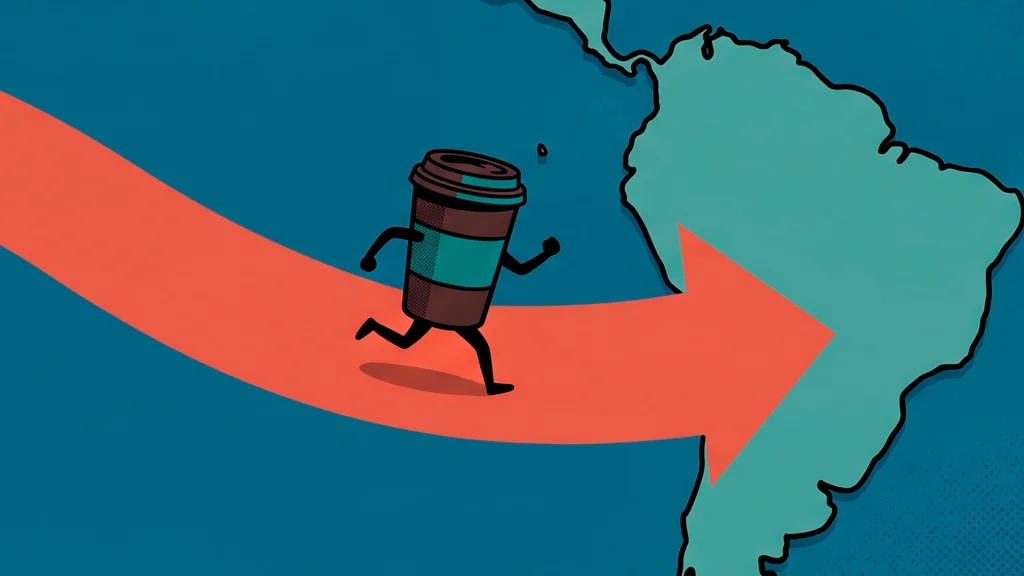
- Brazil is ramping up irrigation in a bid to protect crops from worsening drought
- Arabica prices hit record highs in 2025
- Only 30% of farms are irrigated, but 60M hectares show potential – spurring a push for water access
COFFEE prices are rising, and the world’s most important coffee-growing country is feeling the heat – literally.
Brazil, responsible for over a third of global coffee production, is increasingly turning to irrigation as a defence against erratic rainfall and intensifying droughts – a strategy that could ultimately deepen the problem.
The shift is especially notable in the state of Minas Gerais and the arid northeast region of Bahia, where traditional reliance on rain-fed agriculture has grown riskier in the face of climate change.
Coffee growers have long relied on Brazil’s plentiful spring and summer rains, with droughts considered uncommon. As a result, only about 30% of coffee farms are equipped with irrigation, according to industry estimates.
That’s beginning to shift following last year’s drought. But installing irrigation comes at a cost, especially for farms located far from water sources or where groundwater lies deep below the surface.
It also carries an environmental cost, fuelling a vicious circle: Climate change leads to more dry spells, prompting increased irrigation to meet demand, which in turn strains ecosystems and can exacerbate future drought conditions.
“Irrigation is the major topic in agriculture in Brazil right now,” says Felipe Croce, co-founder and CEO of FAFCoffees, the export company associated with Fazenda Ambiental Fortaleza (FAF) coffee farm in Brazil. “It’s not just in Bahia, but in all states, including previously wetter areas like Sul de Minas.”
“Some improvements have been made in the technology from using more precise drip irrigation which wastes less water than central-pivotal water spraying. However, irrigation used as it is mainly now, in monoculture conventional systems, will be excessive and drain our aquifers and rivers.
There needs to be a clear definition of responsible irrigation – and limits on its use. This must go hand in hand with sustainable farming practices to reduce evapotranspiration. The way things are being done now is a recipe for environmental damage and inevitable water rights conflicts.”
As global coffee prices rise, growers are looking for any means to stabilise their output and secure higher earnings. According to the Brazilian Confederation of Agriculture and Livestock (CNA), Brazil has one of the world’s largest potentials for irrigation expansion, with an estimated 60 million hectares suitable for irrigated agriculture based on soil, climate, and water availability.
But irrigation is not a panacea. Investment costs are steep, and infrastructure – particularly water rights and access – remains a challenge.
In Bahia, concerns are rising over the sustainability of groundwater extraction and river diversion. The São Francisco River – on which many farms depend – faces mounting pressure, with nearly 81% of its total water withdrawals allocated to irrigation, according to national water authorities. Meanwhile, satellite data from Brazil’s National Water Agency (ANA) shows groundwater levels in parts of the region have declined over the past decade, driven by competing agricultural and municipal demands.
Yet as international demand for coffee remains unrelenting, and climate models forecast further rainfall variability in Brazil, irrigation is becoming less of a choice and more of an imperative.
The result is a quiet reshaping of Brazil’s coffee economy – where technology and capital are becoming key differentiators between those who thrive and those who merely survive.
Climate risks and economic strategies
Brazilian farmers have long been masters at navigating uncertainty, but recent years have pushed even their resilience to its limits.
The severe droughts of 2021 and 2022 triggered one of the worst coffee harvests in two decades, with compensation payouts to farmers quadrupling compared to the previous year – sending shockwaves through global supply chains.
Now, in 2025, Brazil is once again in the grip of a worsening drought, with projections of extreme weather persisting, raising concerns for agribusiness.
Futures prices have surged in response, with arabica surpassing $4.30 per pound, reaching record highs. However, a recent Reuters poll suggests that these high prices may curb demand, potentially leading to a 30% decrease in arabica futures by the end of 2025.
Some industry observers note that narratives around poor weather, whether organic or amplified, have market consequences. While producers genuinely face hardship, talk of shortfalls often nudges prices upward, fuelling a cycle of speculation and media alarm.
“The question of climate-driven supply is, unfortunately, a reality,” says Felipe. “We’ve been dealing with five consecutive years of climate-related challenges firsthand. It’s affecting supply and forcing the rest of the world to finally take notice. The key difference now is that origin can’t be ignored anymore – even by those who used to look the other way.”
Yet this attention often masks deeper structural issues. Brazil’s accelerated pivot to irrigation – a response to increasingly erratic rainfall – reflects a broader global trend: The race to insulate agriculture from climate shocks, often at environmental or social cost.
Access to irrigation is not equal. Larger, well-capitalised farms can invest in infrastructure, drought-resistant varieties, and climate tech. Smaller farms, particularly in regions like Espírito Santo or Pará, often lack these buffers, leaving them more exposed and less competitive.
Environmental concerns are growing too. In Bahia, for example, critics have flagged deforestation and pressure on wetlands linked to expanded irrigation. The São Francisco River, a vital source for many farms, is under growing stress.
In this context, how Brazil manages productivity and ecological responsibility will shape more than exports – it will shape its global reputation. With buyers under increasing ESG scrutiny, sustainable production is no longer optional.

Balancing short-term needs with long-term sustainability
The rise of irrigation in Brazil’s coffee belt underscores the tension between short-term necessity and long-term sustainability.
On the one hand, no one disputes the need to protect livelihoods and meet rising global demand. On the other, irrigation poses resource trade-offs in a country already strained by deforestation, desertification, and water scarcity.
Brazil has made some moves to reconcile these pressures. The federal government has pledged to expand technical support for irrigation management and is pushing for greater adoption of precision agriculture, with some calling irrigation “the fourth agricultural revolution” in Brazil.
Programmes are also underway to develop climate-smart coffee varieties that are both drought-tolerant and lower in water demand. Meanwhile, some cooperatives are trialling drip irrigation and sensor-based soil monitoring systems to reduce water waste.
Still, scaling these innovations remains a challenge. Only around 12% of Brazil’s total farmland is irrigated, according to the Ministry of Agriculture, suggesting huge untapped potential but also logistical hurdles. In coffee specifically, adoption is uneven – largely favouring commercial arabica farms with access to credit and export markets.
Smallholders often lack the resources to make the transition.
This asymmetry risks exacerbating inequalities within the sector and undermining the broader sustainability narrative. The paradox of climate change adaptation is that it can reinforce the very vulnerabilities it seeks to address – unless paired with inclusive policies.
That includes support for water governance frameworks, rural financing, and environmental safeguards.
“Support is key,” says Felipe. “We need initiatives from both companies and government to help educate small farmers on simple, effective techniques to better cope with drought, heat, and other climate challenges.”
“Just as important is consumer support – choosing to back smallholder and regenerative farms. Without that, the gap will only grow wider.”
In the end, coffee’s future may depend less on rainfall than on regulation and redistribution. The global market wants more beans, and Brazilian farmers – resilient and resourceful – are ready to deliver.
But at what cost, and with whose water? That is the question policymakers, industry players, and consumers must confront before the next drought hits.
Coffee Intelligence
Want to read more articles like this? Sign up for our newsletter here.