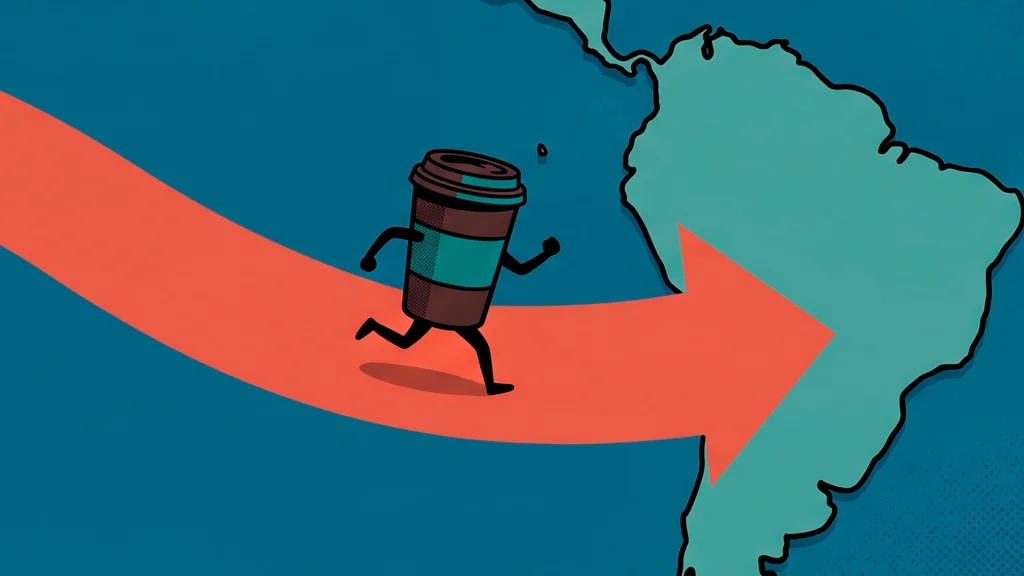
- Trump’s tariff plan puts U.S. coffee imports – worth $8.2B in 2023 – at risk
- After decades of duty-free coffee, new tariffs could squeeze importers, retailers, and millions of consumers
- Mexico and Canada brace for impact as the first in line, but more could follow soon
THE coffee industry, a $460 billion global market, is facing an uncertain future as protectionist trade policies threaten supply chains, pricing, and consumer habits.
With the U.S. importing over $8.2 billion worth of coffee in 2023, the proposed “Reciprocal Trade Act” and renewed tariff disputes are set to reshape the coffee trade, potentially making the morning cup far more expensive.
“With 70% of American adults drinking coffee each week (compared, for example, to just 10% of Americans who eat eggs each day) and already challenged by high grocery prices, any increases in coffee prices would be a highly visible sign of the worsening cost of living crisis,” says William “Bill” Murray, CEO and President of the National Coffee Association (NCA).
At the heart of the controversy is Donald Trump’s aggressive trade agenda, which seeks to impose tariffs on U.S. imports equivalent to those that foreign governments impose on American goods. While the stated intention may be to level the playing field, the consequences for coffee importers and consumers could be severe.
“If reciprocal tariffs are imposed, U.S. importers could face rates between 0% and 45% on coffee, depending on the source,” speculates Peter Bay Kirkegaard, Leading Senior Advisor at the Confederation of Danish Industry.
“10% to 15% from Colombia, 10% to 15% from Honduras, Guatemala, and Nicaragua, and up to 45% from Mexico. Since the U.S. mostly doesn’t grow coffee and imported $8.2 billion worth in 2023 under a 0% tariff, these new rates would significantly raise coffee prices – along with many other goods – for everyday Americans.”
Meanwhile, Canadian coffee, largely duty-free under existing agreements, could be caught in the broader trade war, as seen in previous tariff battles on aluminium and steel.
For decades, coffee has entered the U.S. tariff-free, a reflection of the country’s total dependence on foreign production. Unlike aluminium, steel, or automobiles, coffee is not a broadly domestically produced commodity, making tariffs an unusual – and costly – policy choice.
The NCA has warned that imposing duties on coffee would be disastrous for importers and consumers alike – stating that coffee should be exempt from additional tariffs, which would affect three in four Americans.
“Coffee cannot grow in most of the United States,” says Bill. “That means U.S. coffee drinkers, coffee businesses, and 2.2 million U.S. jobs rely on stable, secure trade.”
“It’s important to emphasise that after being imported from countries with suitable climates, unroasted (or ‘green’) coffee beans are transported, stored, roasted, prepared, and sold by coffee businesses in every U.S. state and territory – supporting these U.S. jobs and generating $343 billion in economic activity every year. That is, for every dollar of coffee-related imports, coffee generates $43 in value for the U.S. economy.”
The outcome? Higher prices at every level. The average retail price of coffee in the U.S. has risen significantly since 2021, largely due to supply chain disruptions and inflation. Tariffs would add further pressure, potentially pushing retail coffee prices up even more.
While American consumers might be willing to pay more for their premium Starbucks or Dunkin’ fix, the burden would fall hardest on lower-income households that rely on budget-friendly brands.
Beyond price hikes, logistical headaches await U.S. importers.
“The current U.S. Harmonized Tariff Schedule (HTS) contains approximately 11,400 tariff lines, but under the reciprocal model, each product would face country-specific duties,” says Peter. “This means importers would need to juggle over 2 million potential tariff lines, adding bureaucratic complexity to an already volatile business.”
Mexico, Canada, and the supply chain at risk
While the coffee trade war is global, the most immediate casualties would be Mexico and Canada.
Mexico exported $369 million in coffee to the U.S. (its largest share) in 2023. Estimated impact of tariffs on Mexican coffee, according to the Observatory of Economic Complexity (OEC), is $109 million. A 25% tariff on Mexican coffee would significantly disrupt trade, potentially rerouting supply chains to non-tariffed countries.
Canadian coffee, which benefitted from the U.S.-Mexico-Canada Agreement (USMCA) until recently, faces its own uncertainties since March 6th, when President Trump announced that 25% tariffs would be waived on goods that qualified under the USMCA – for Canada, coffee does not, and the sector has been impacted by the 25% tariff already.
“Coffee trade is global and intertwined,” says Bill. “Tariffs on coffee from Mexico and Canada have a negative impact on the overall U.S. market, and impact already high coffee prices.”
Although Canada is not a major producer, it is a key processing and distribution hub, importing beans, roasting them, and re-exporting them to the U.S. A breakdown in trade relations could jeopardise this flow, harming Canadian coffee businesses reliant on U.S. buyers. OEC’s estimated tariff impact on Canadian coffee is $277 million.
Retailers and supermarkets are already pushing back against price increases from suppliers. JDE Peet’s, one of the world’s largest coffee companies, has faced resistance in Europe, where major grocery chains are refusing to stock its products due to price hikes.
If the U.S. market follows suit, coffee companies may struggle to pass on higher costs to consumers, squeezing their margins even further.
The broader question is whether U.S. policymakers are willing to accept the unintended consequences of their trade policies.
“By matching U.S. import tariffs to those of its trading partners, Trump would effectively outsource U.S. trade policy to foreign governments, allowing them to dictate tariff levels,” says Peter.
“This move would also create a bureaucratic burden for U.S. importers. Typically, countries use tariffs to protect domestic industries while ensuring affordable access to goods they don’t produce. Since the U.S. doesn’t grow coffee [except in Hawaii and Puerto Rico, whose combined production is reportedly less than 1% of what the U.S. consumes], it maintains a 0% tariff on all coffee imports – non-roasted, roasted, and ground.”
While tariffs are often used to protect domestic industries, in the case of coffee, they serve no such purpose – there is isn’t a substantial enough American-grown alternative.
Instead, they could harm farmers in Mexico and Central America, further destabilising the region and increasing migration pressures.
“So far, coffee has been classified as a national product in Mexico under the USMCA trade rules,” says Yolanda Beatriz Hernández Escárcega, Communication Lead at IWCA Mexico, Director of Organizational Development at Consultores Soc. Coop. de RL de CV, and producer of “Yalí,” a women’s coffee from Puebla, Mexico. “In March, the U.S. agreed to a 30-day tariff truce, which is set to expire on April 2.”
“If U.S. importers are responsible for paying the tariffs, the cost will inevitably be passed on to consumers, increasing retail prices. If a 25% tariff is imposed on coffee, Mexican exporters will lose competitiveness due to higher prices for consumers. Producers who rely on these exporters will also be affected, as companies may reduce purchases or lower the prices they pay for coffee.”

Who’s next? The global fallout
Coffee is not the only industry under fire. The Trump administration’s trade policies have targeted multiple sectors, with reciprocal tariffs potentially hitting imports from what Trump refers to as the “Dirty 15″ – or the 15% of countries that have the highest tariffs and largest trading volumes with the U.S.
For coffee, this means that nearly every major supplier is at risk of new duties.
Brazil, the world’s largest coffee exporter, sent over $1.33 billion worth of coffee to the U.S. in 2023. While the country currently enjoys a 0% tariff on exports to the U.S., Trump’s model could see this change, depending on Brazil’s own tariff policies on American goods – although for the time being Brazil’s Finance Minister has said it won’t immediately retaliate against tariffs imposed by the U.S. on steel and aluminium imports.
Vietnam, another major supplier, could also be drawn into the tariff web, further complicating the market. In 2024, Vietnam’s trade surplus with the U.S. hit a record $140 billion, up nearly 20% from the previous year. This surplus equals one-third of Vietnam’s GDP, highlighting the U.S. market’s crucial role.
Trump’s tariff plan impacts on the coffee industry and the people behind it will ultimately depend on selected countries, and selected goods from these countries.
The impact extends beyond just trade flows. If coffee prices rise significantly, consumption habits may shift.
The specialty coffee boom of the past decade, driven by an appetite for high-quality, single-origin beans, could slow as consumers seek cheaper alternatives. Large coffee chains may be forced to adjust their pricing strategies or absorb costs, leading to lower profit margins.
Moreover, the supply chain disruptions caused by tariffs could exacerbate existing challenges in the coffee sector, including climate-related crop failures and transportation bottlenecks.
With Arabica prices already at record highs due to poor harvests in Brazil and Colombia, tariffs would add another layer of uncertainty to an industry already on edge.
The larger question is whether the trade war will push coffee-producing nations closer together, creating new alliances that bypass the U.S. market. The EU, which has been actively negotiating trade agreements with Latin America and Africa, could become a more attractive destination for coffee exporters seeking stability. However, newly adopted regulations – such as mandatory human rights and environmental due diligence requirements – may pose additional compliance challenges for many producers and exporters.
Meanwhile, China’s growing coffee culture presents another alternative, with imports of coffee, tea and spices soaring 32.5 percent year-on-year, according to 2024 data from the General Administration of Customs.
In short, the trade war risks fragmenting global coffee supply chains, forcing exporters to rethink their dependence on the U.S. market. If tariffs persist, American consumers may wake up to a world where their coffee costs significantly more – if they can find their favourite beans at all.
The coffee industry is bracing for turbulence as U.S. trade policies become increasingly protectionist. While the Trump administration argues that reciprocal tariffs will protect American jobs, in the case of coffee, they serve only to inflate costs for consumers and disrupt well-established supply chains.
“Coffee has been the most popular beverage in America for decades and has even been recognised as part of healthy diets,” says Bill. “More Americans drink coffee each day than any other beverage, which not even the pandemic changed.”
“Given coffee’s critical role in Americans’ daily lives, the National Coffee Association is committed to working with all stakeholders around the world and throughout the coffee community to ensure Americans can continue to enjoy their favourite beverage.”
Ultimately, coffee tariffs could backfire – harming businesses, alienating trade partners, and driving up costs in a sector that relies almost entirely on foreign production.
Coffee Intelligence
Want to read more articles like this? Sign up for our newsletter here.